
The Federal Government's changes to negative gearing and capital gains tax (CGT) have now passed into law.
While the reforms represent one of the biggest changes to investment property taxation in many years, they won't affect everyone in the same way. Much depends on when your property was purchased and whether it qualifies as a new build.
Here's what we know so far.
Existing investment properties remain unchanged
If you purchased an investment property before 7:30pm on 12 May 2026, the current negative gearing rules continue to apply.
This means you can continue claiming eligible investment property losses against your taxable income under the existing rules.
Negative gearing will end for many future property purchases
For investment properties purchased after 7:30pm on 12 May 2026, negative gearing will only be available until 30 June 2027.
From 1 July 2027, losses on these properties will no longer be able to be offset against your other taxable income.
This change only applies to properties purchased after the announcement date.
New builds will be exempt
The Government has confirmed that qualifying new build properties will remain exempt from the new negative gearing restrictions, regardless of when they are purchased.
The Australian Taxation Office (ATO) is yet to release detailed guidance on exactly which properties will qualify as a new build under these rules.
If you're considering purchasing a newly constructed property, it will be important to confirm whether it meets the eligibility requirements once further guidance becomes available.
Capital gains tax changes from 1 July 2027
The current 50% capital gains tax discount for individuals will be abolished from 1 July 2027.
Instead, taxpayers will be able to increase the cost base of eligible assets each year using an inflation index. The ATO will release further information on how this indexation will operate and the annual rates that will apply.
A minimum effective tax rate of 30% on capital gains will also apply under the new rules.
What about assets acquired before capital gains tax existed?
Assets acquired before the introduction of capital gains tax (commonly referred to as pre-CGT assets) will continue to retain their exempt status for any gains accrued up to 30 June 2027.
However, any increase in value from 1 July 2027 onwards will become subject to the new capital gains tax rules.
What should investors do now?
For many existing investors, there may be little immediate action required.
However, if you're:
- considering purchasing an investment property
- planning to sell an investment property after 1 July 2027
- reviewing your long-term investment strategy
it's worth understanding how these changes may affect your future tax position.
As further guidance is released by the ATO, particularly around new builds and the new indexation methodology, we'll continue to keep you informed.
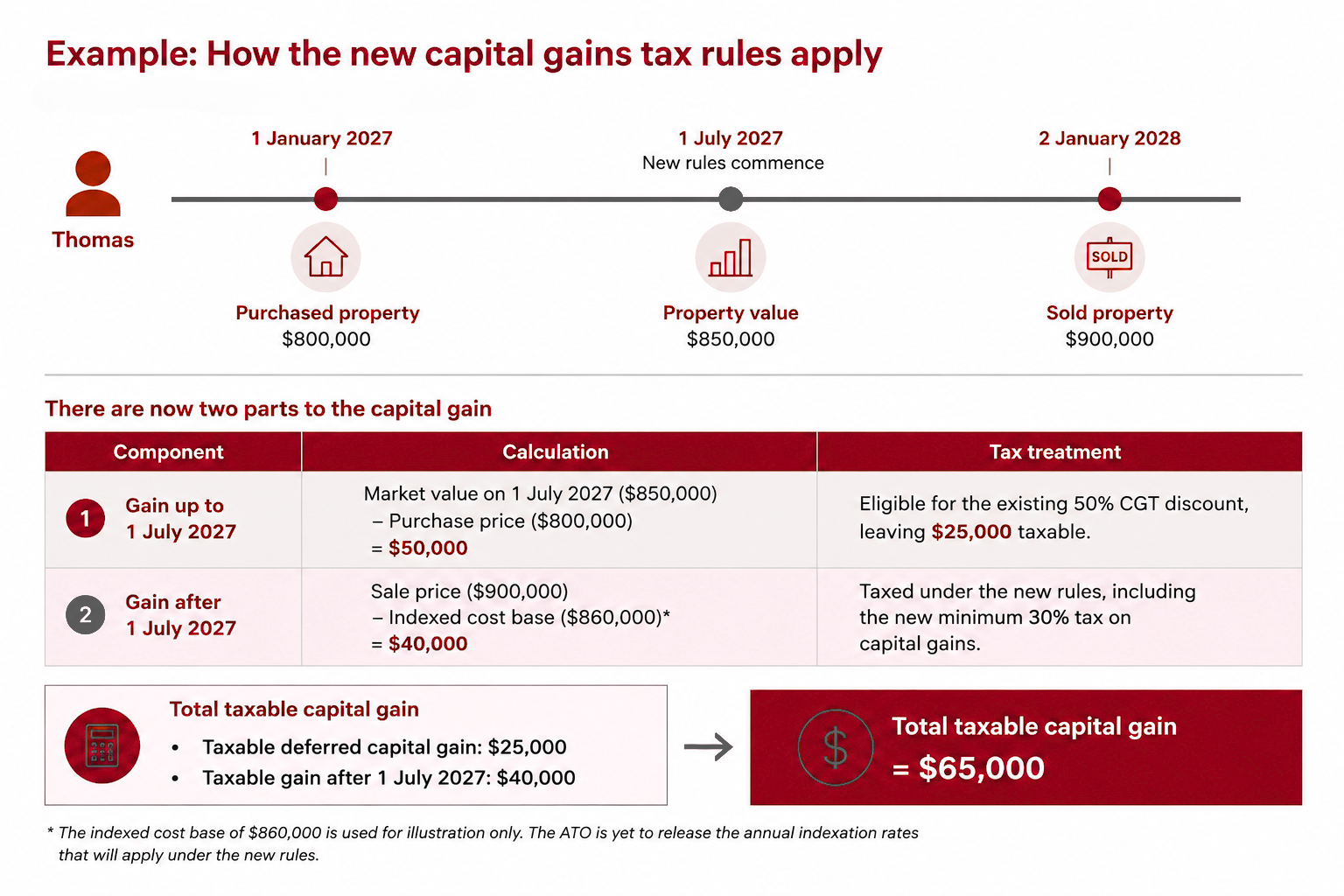
Working example of how the new capital gains tax rules work
Thomas purchased an investment property for $800,000 on 1 January 2027.
On 1 July 2027, when the new rules commence, the property is valued at $850,000.
Thomas sells the property on 2 January 2028 for $900,000.
What this example shows
The increase in value before 1 July 2027 continues to receive the existing CGT discount. Any growth after 1 July 2027 is taxed under the new capital gains tax rules.
We're here to help
These changes are significant, but the impact will differ depending on your circumstances.
If you'd like to understand how the new rules may affect your investment strategy, speak with the team at hmh Advisory. We can help you assess your options and plan with confidence.